Construction & Safety
Site Induction Redesign
A standard site induction - wall of text, list of rules, quiz at the end - rebuilt from the ground up around the question that actually matters: what does a worker need to know, and act on, when it counts?
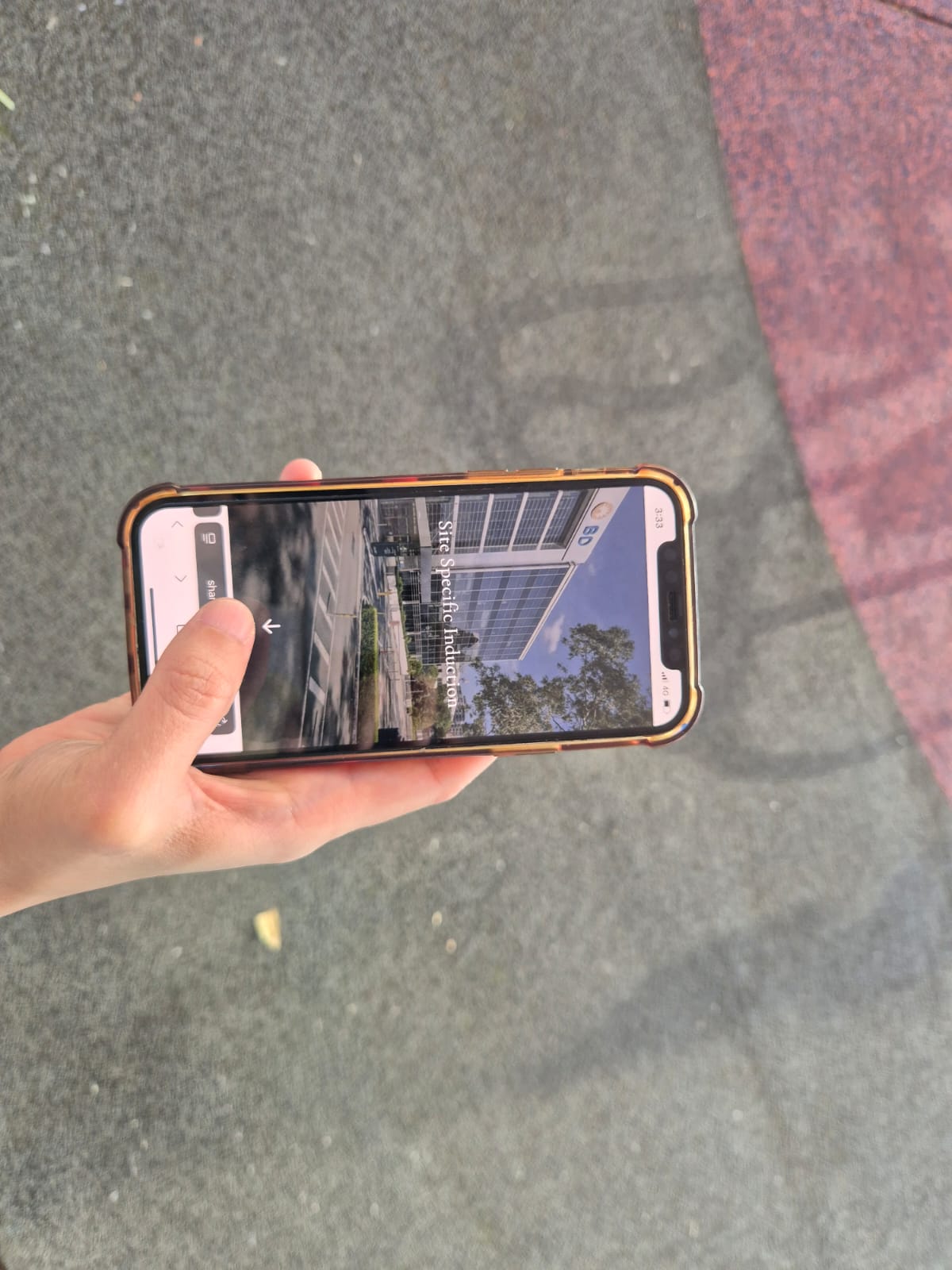
The brief
- Industry
- Construction & property
- Format
- eLearning module
- Tool
- Articulate Rise
The client had an existing site induction that workers were expected to complete before stepping on site. It covered the right topics - hazards, permits, sign-in procedures, emergency protocols - but it covered them the wrong way.
Information was presented as a series of text-heavy slides with a compliance quiz bolted on at the end. Workers clicked through to get the green tick. Managers checked the record. Behaviours on site remained unchanged.
The brief was to rebuild it - not refresh it. To design something that actually prepared workers for the decisions they'd face on site.
The problem
Knowing the rule isn't the same as knowing what to do.
The original induction told workers that traffic on site was a hazard. It didn't put them in the moment where a truck is reversing and they need to make a call.
The original induction told workers to obtain all necessary permits before commencing work. It didn't show them what happens when someone pressures them to just start while the permit is being sorted.
What does a worker actually need to know - and act on - when it counts?
That question shaped every design decision that followed.
Before & after
This is what the difference looks like.
Same topic. Same compliance requirement. Completely different experience.
Before — original induction
5.0 Site specific hazards
Throughout the site there are a number of site specific hazards, including:
- · Hazardous chemicals
- · Asbestos
- · Traffic (trucks, other cars, trains)
- · Falls from height (roof areas)
- · Overhead power lines
Any works that you undertake should take into account these site specific hazards and your SWMS should identify, assess and control these risks.
One interaction in the entire course. Quiz at the end.
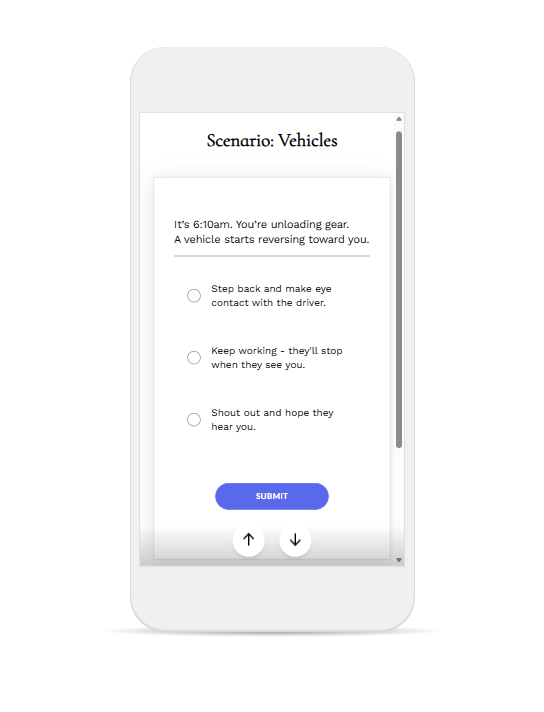
After — Atrium redesign
Before — rules as a list
8.0 Permits
This site has the following permit to work systems in place:
- · Hot Works Permit
- · Confined Space Entry Permit
- · Asbestos & Hazardous Materials Permit
- · Excavation Permit
- · Roof Access Permit
- · Working at Heights Permit
- · Permit to Drill, Cut or Core
It is your responsibility to obtain all necessary permits prior to commencing any works on site.
After — moment of friction
What changed
Instead of listing the three biggest risks,
we put workers inside them - a scenario at 6:10am, unloading gear, a vehicle reversing toward them. A real decision, not a fact to memorise.
Instead of telling people to sign in,
we showed them why it matters - if you're not on the list, no one knows you're on site when something goes wrong.
Instead of a permit checklist,
we built a moment of friction - you're asked to just start while the permit is being sorted. What do you do?
Instead of a quiz at the end,
we embedded decisions throughout - five behaviours, six scenarios, every one grounded in something that happens on this site.
Completion was never the goal.
People going home safe was the goal.